
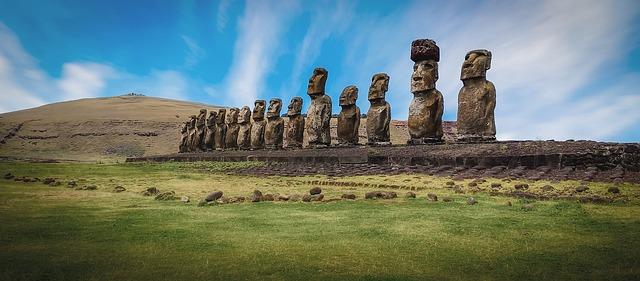
New Insights Reveal How Easter Island’s Statues ‘walked’ – A Binghamton University Study Highlights the Physics Behind the Phenomenon
In a groundbreaking study,researchers from Binghamton University have shed new light on the iconic moai statues of Easter Island,challenging centuries of debate about their transportation.For years,the origin of these giant stone figures has puzzled scholars and captivated the imaginations of tourists drawn to the remote island. Traditional theories suggested that the 13-ton statues were moved using a combination of manpower and simple tools. However, the latest research posits that the statues may have actually ‘walked’ to their locations, propelled by clever techniques involving physics and ingenuity. This revelation not only enhances our understanding of the Rapa Nui civilization’s technological capabilities but also invites further exploration into the strategies used in one of history’s most enigmatic and enduring marvels.
Easter Island’s Statues: New Research Reveals Mechanism Behind Their Movement
Recent studies from Binghamton University have shed new light on the mysterious monolithic statues of Easter Island, commonly known as Moai. For years, researchers debated how these enormous stone figures were transported across the island, with theories ranging from simple sledding to wooden rollers. However, the latest findings suggest that the Moai were not merely dragged or rolled; instead, they may have been capable of a unique form of movement that resembles ‘walking.’ This process likely involved a coordinated effort where teams of workers utilized a sophisticated method to rock the statues back and forth,shifting their weight to propel them forward.
The implications of this research extend beyond just the mechanics of moving the statues. Environmental factors played a significant role, as the researchers noted that the island’s topography and the stones’ weight necessitated innovative solutions. key elements contributing to their movement include:
- Human Coordination: Extensive teamwork was essential for executing the walking technique.
- Terrain Adaptation: The varying landscape of Easter Island influenced how the statues were maneuvered.
- Material Friction: The surface textures of the statues and the ground interacted in ways that facilitated this movement.
These revelations challenge long-standing beliefs about Easter island’s cultural practices and highlight the ingenuity of its early inhabitants, providing a clearer picture of how artistry and engineering combined to shape one of the world’s most enigmatic landscapes.
The Physics of Walking Statues: Insights from Binghamton University’s Groundbreaking Study
The recent study conducted by researchers at Binghamton University has unveiled a captivating theory about Easter Island’s iconic Moai statues, suggesting that they didn’t just stand still, but rather ‘walked’ across the landscape. This revolutionary idea centers around the physics of motion and the application of principles akin to a rocking motion, akin to how one might rock a heavy object to maneuver it. By employing precise modeling techniques and simulations, the researchers demonstrated that with the right methods, such as utilizing ropes and coordinated team efforts, these massive stone figures could have been shifted across the island with intentional, albeit labor-intensive, movement.
the findings underscore the importance of cultural practice in conjunction with physical principles.Researchers highlighted several key factors influencing the ‘walking’ motion of the statues, including:
- the center of gravity: Properly balancing the statues would be vital to initiate movement.
- Team dynamics: A coordinated effort among the laborers would be necessary to achieve the desired results.
- Environmental considerations: The terrain’s characteristics could either hinder or facilitate the movement.
This innovative research not only challenges previous assumptions about the static nature of the Moai statues but also sheds light on ancient Rapa Nui engineering techniques, potentially redefining our understanding of their cultural and ancient significance.
recommendations for Future Research: Unraveling the Mysteries of Easter Island’s Moai
Future investigations into the enigmatic Moai statues of Easter Island should prioritize a multidisciplinary approach that integrates archaeology, anthropology, and advanced technology. Research could focus on the indigenous Rapa Nui culture, delving deeper into their practices and techniques used in the quarries and transportation of the statues. By employing cutting-edge scanning and modeling technologies, researchers can create detailed replicas of the moai to test various theories regarding their movement, including the principle of “walking” with the use of ropes, as suggested by recent findings. Further examination of archaeological sites and the surrounding ecosystem will also enhance our understanding of the environmental impacts on the Rapa Nui civilization and how it influenced the construction and placement of these iconic figures.
additionally, expanding the geographical lens of the research could yield captivating insights. Investigating similar megalithic sites across the globe may reveal common threads in the methods of statue creation and transportation, thus contributing to a larger narrative about prehistoric engineering prowess. collaborative efforts with physicists could also refine models of biomechanics relevant to moving these massive stones, allowing for experimental demonstrations that recreate the ancient methods posited by scholars. A broader dialog with local communities about the cultural significance of the Moai will not only enrich the academic discourse but also ensure that ongoing research honors the traditions and voices of the Rapa Nui people, making future studies a shared journey of discovery.
Key Takeaways
the groundbreaking research from Binghamton University offers a fresh perspective on the marvels of Easter Island, suggesting that the iconic Moai statues did not merely stand idle, but instead were capable of moving upright across the landscape. By utilizing principles of physics and innovative simulations, researchers have illuminated a potential method for how these massive stone figures were transported by the island’s early inhabitants. as the academic community continues to unravel the mysteries surrounding these ancient monuments, this study not only enhances our understanding of the ingenuity of the Rapa Nui people but also underscores the importance of interdisciplinary approaches in solving historical enigmas. As we look to the future, the findings may encourage further exploration into the methods of transportation and construction used by civilizations long gone, reminding us of the remarkable feats human creativity can achieve, even in the face of formidable challenges.










