Southeast Asia’s Solar Module Production Growth: A Comprehensive Overview
Expansion of Manufacturing Capacity in the Region
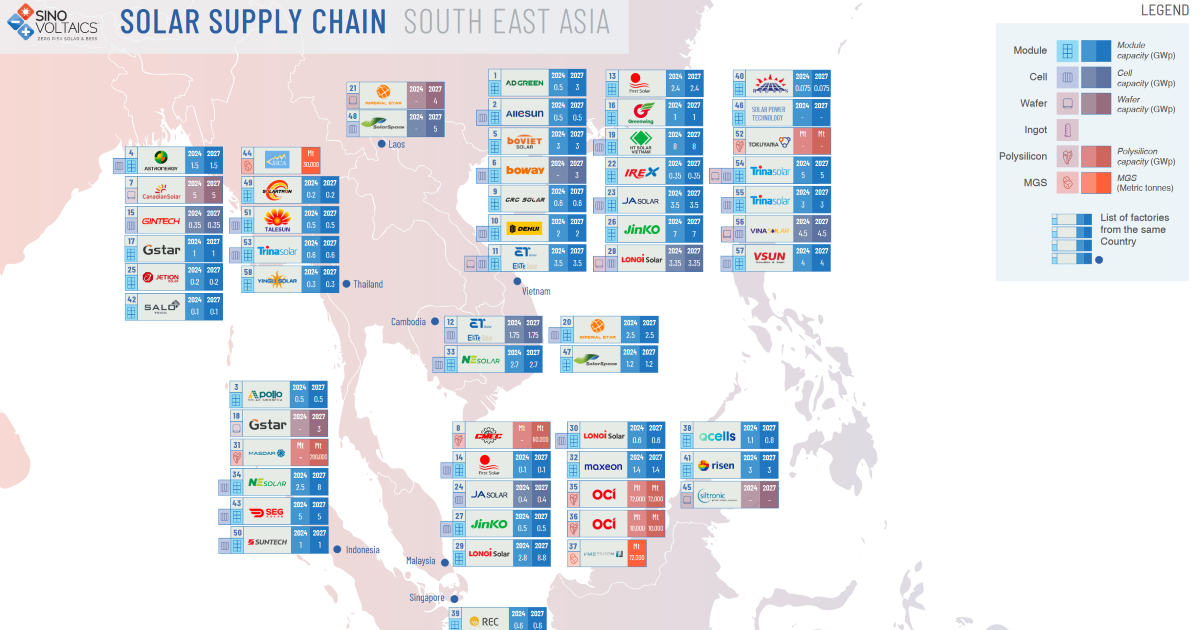
A recent analysis from Sinovoltaics has revealed significant advancements in solar module production capacity across Southeast Asia. According to their latest supply chain map, the region’s total module capacity now stands at an impressive 78.8 GW, with 58 active production projects identified as of October 8, 2024.
Key Increases and Future Projections
In a detailed statement, Sinovoltaics analysts highlighted several essential developments since their last report published in the first quarter of this year. The data collected from various market press releases points to an additional 14 GW of solar module capacity scheduled for rollout between 2027 and 2030. The anticipated growth trajectory for cell production is expected to escalate from the current figure of 50 GW to a noteworthy 68 GW within this timeframe. Furthermore, ingot manufacturing capabilities are projected to increase from around 23 GW to approximately 32.6 GW.
New Projects on the Horizon
The report showcases numerous exciting new projects emerging throughout Southeast Asia. For instance:
- Elite Solar is spearheading initiatives in Cambodia.
- In Laos, both Imperial Star Solar and SolarSpace are making strides.
- Vietnam sees contributions from BoWay Solar Power Technology and CRC Solar.
- Indonesia welcomes developments through partners like Gstar, while Thailand also witnesses growth.
- Government Incentives: Many Southeast Asian countries have implemented attractive policies and incentives to promote the use of solar energy.
- Declining Costs: The cost of solar technology has significantly decreased, making it more accessible to both homeowners and businesses.
- Growing Energy Demand: With rising populations and industrial growth, the demand for sustainable energy sources is greater than ever.
- Climate Commitments: Countries in the region are eager to meet international climate pledges, particularly in reducing carbon emissions.
- Environmental Impact: Reducing greenhouse gas emissions and reliance on fossil fuels leads to a cleaner environment.
- Energy Independence: Countries can lessen their dependence on imported energy sources through local solar production.
- Job Creation: The growing solar market generates new jobs in manufacturing, installation, and maintenance.
- Economic Growth: Investments in renewable energy catalyze economic development and technological innovation.
People Also Asked
“`html
Unleashing Solar Power: Sinovoltaics Reveals 78.8 GW Solar Module Surge in Southeast Asia
Understanding the Surge in Solar Module Installations
Sinovoltaics, a leading name in the solar energy sector, recently reported an impressive 78.8 GW surge in solar module installations across Southeast Asia. This remarkable increase underscores the region’s commitment to renewable energy and sheds light on the factors driving this solar power revolution.
Key Reasons for the Solar Boom in Southeast Asia
Solar Power Trends in Southeast Asia
The solar power landscape in Southeast Asia is vibrant and evolving rapidly. Here are some notable trends shaped by the 78.8 GW solar module surge:
1. Increased Adoption of Distributed Solar
More homeowners and businesses are investing in rooftop solar systems to reduce energy costs and reliance on conventional grids.
2. Utility-Scale Solar Farms
Utility-scale solar projects are becoming commonplace, with countries like Thailand and Vietnam leading the way in large-scale solar power generation.
3. Technological Innovations
Advancements in solar technology, such as bifacial panels and energy storage solutions, are enhancing efficiency and reliability.
Benefits of Solar Energy in Southeast Asia
The shift to solar energy offers numerous benefits to Southeast Asia, including:
Practical Tips for Leveraging Solar Power
If you’re someone contemplating solar energy for your home or business, consider the following practical tips:
Evaluate Your Energy Needs
Assess your current energy consumption to determine the size of the solar system that best fits your requirements.
Explore Financing Options
Look into government incentives, tax credits, and financing plans to reduce the initial costs of installing solar panels.
Choose the Right Location
Ensure your solar panels are installed where they can receive maximum sunlight exposure without obstructions.
Stay Informed About Technology
Keep up with developments in solar technology to make informed decisions about your investments in solar power.
Case Studies: Success Stories in Solar Adoption
A variety of countries in Southeast Asia have successfully harnessed solar power, showcasing its immense potential. Here are a few inspiring case studies:
Thailand’s Solar Energy Revolution
Thailand has emerged as a regional leader in solar power, with over 3.5 GW of installed capacity. The government’s “Feed-in Tariff” program incentivized significant investments in solar, making it a cornerstone of the nation’s energy strategy.
Vietnam’s Rapid Growth
Vietnam has witnessed unprecedented growth, with installed solar capacity surpassing 16 GW in just a few years. Driven by favorable policies and high energy demand, the country’s solar market is poised for continued expansion.
First-Hand Experiences: Solar Users Share Their Stories
Real-life experiences can provide valuable insights into the benefits and challenges of solar power. Here are a couple of testimonials:
John’s Experience in Malaysia
“Since installing solar panels on my roof last year, my electricity bills have decreased by over 50%. The installation process was straightforward, and I feel great knowing I’m contributing to a cleaner environment.”
Maria’s Journey in the Philippines
“Transitioning to solar energy has been empowering. We’re generating our own power and even selling surplus energy back to the grid through net metering.”
Embracing the Future of Solar Energy in Southeast Asia
The 78.8 GW solar module surge reported by Sinovoltaics marks a pivotal moment in Southeast Asia’s energy landscape. With governmental support, technological innovations, and a growing awareness of the value of sustainable practices, the region is well on its way to becoming a leader in solar energy adoption.
HTML Table: Solar Capacity Growth by Country
| Country | Installed Capacity (GW) | Annual Growth Rate (%) |
|---|---|---|
| Thailand | 3.5 | 20 |
| Vietnam | 16.5 | 50 |
| Philippines | 1.2 | 15 |
| Malaysia | 1.0 | 10 |
The Community’s Role in Solar Growth
Community engagement is crucial for fostering a supportive atmosphere for solar development. Awareness campaigns and educational programs can demystify solar energy and drive public interest.
Final Thoughts on Solar Module Surge
As we witness the solar module surge in Southeast Asia, it becomes increasingly clear that rooftop solar systems, large-scale solar farms,
Compared with previous reports which tracked only 50 projects, it’s encouraging to note that this figure has now risen to a total of 58 active production initiatives across countries including Cambodia, Indonesia, Laos, Malaysia, Singapore, Thailand, and Vietnam.
Details on Current Operations
The updated map not only catalogs each factory’s output potential for both the years 2024 and 2027, but also provides insights into ownership structures involving major players such as JA Solar, SEG Solar, Maxeon Technologies Corp., TrinaSolar Inc., and JinkoSolar Holding Co., Ltd.. It’s worth mentioning that sites dedicated solely to building-integrated photovoltaic (BIPV) modules were excluded from this round-up.
Accessing Essential Information
For those interested in diving deeper into these findings or leveraging them for strategic decisions within their own operations or investments in renewable energy sources like solar power—complete access is provided freely via downloads of the Sinovoltaics Supply Chain Map tailored specifically for Southeast Asia.
Sinovoltaics updates its comprehensive solar supply chain maps every quarter encompassing regions such as India and Europe alongside North American manufacturing hubs. These resources furnish critical details about multimillion-dollar investments concerning facilities’ sizes—including equipment dedicated towards producing PV modules as well as cells; wafers; ingots; polysilicon; among other vital materials necessary in crafting high-performance renewable technologies.
This content remains protected under copyright legislation but opportunities may exist should organizations want permission or guidelines pertaining directly towards content reuse inquiries via contacting: [email protected] .